
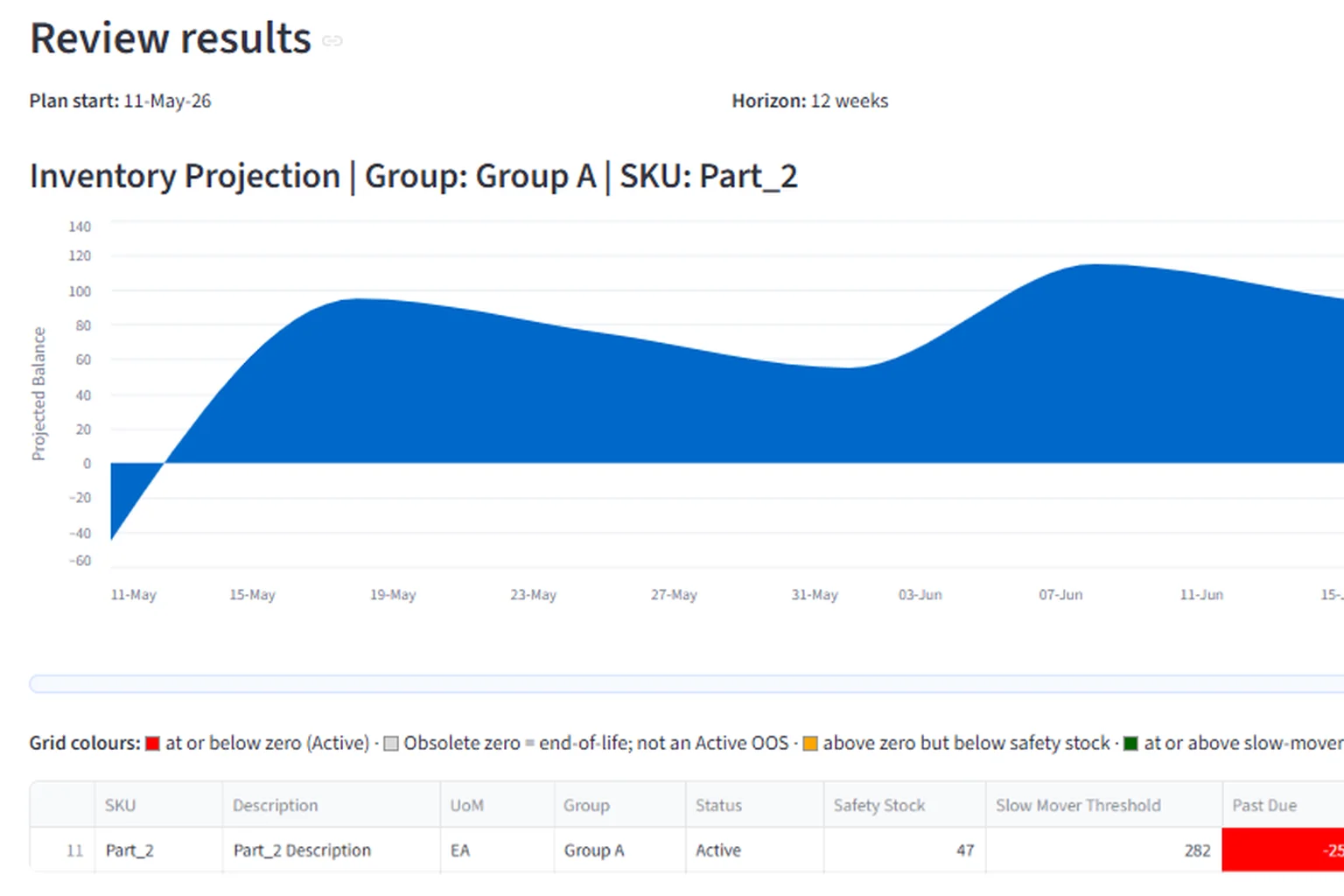
A simple stock report can tell you whether there is more supply than demand overall. That can be useful, but it does not tell you whether the stock will be available when it is needed.
This is the problem MRP is designed to solve. A business may have enough stock and purchase orders in total for the next three months, yet still face a shortage next week because the next delivery is due too late. Equally, stock may look low today but be perfectly adequate once a confirmed receipt due tomorrow is considered.
MRP, or Material Requirements Planning, is a time-phased calculation that determines when and how much supply is required for an item at a location. The time element is what separates a genuine MRP calculation from simply comparing total stock, total demand and total supply.
A stock balance without dates can hide the real problem
Consider an item with 100 units in stock and total demand of 100 units over the next month. At first glance, the position looks balanced.
But suppose 80 units are required in the first week and the remaining 20 are required in the fourth week. The business has no room for a late delivery, a demand increase or a requirement to maintain buffer stock. If an open purchase order for 100 units is not due until the end of the month, it does nothing to solve the first-week requirement.
MRP works through this sequence rather than looking only at totals. It asks a more useful question: **after each expected demand and supply event, what will the projected stock position be?**
That projected stock position is usually calculated in defined time buckets, such as days, weeks or planning periods. The appropriate level of detail depends on the business. A fast-moving operation may need a daily view, while a slower-moving business may plan effectively by week or month.
Time-phasing is what makes MRP different
This is an important distinction because I have worked with ERP systems that described themselves as having MRP, but the calculation they performed was not what I would consider a true time-phased MRP calculation.
The system would take the demand, perform a bill of materials (BOM) explosion and offset the resulting requirements using lead times. That can be useful for working out what materials are required and when they need to be available for production, but it is different from continuously calculating the projected stock position through time.
A time-phased MRP calculation is concerned with what happens to the inventory position in each time bucket. It considers the current stock position, the demand due in that period, existing supply due in that period and the relevant planning parameters, then carries the resulting projected stock position forward into the next period.
For example:
| Period | Opening stock | Demand | Existing supply | Projected stock | |---|---:|---:|---:|---:| | Week 1 | 100 | 80 | 0 | 20 | | Week 2 | 20 | 40 | 100 | 80 | | Week 3 | 80 | 20 | 0 | 60 |
The important point is not simply that there are 180 units of supply available against 140 units of demand. The important point is **when the supply becomes available**.
If the 100-unit receipt in Week 2 were instead due in Week 3, the business would have a shortage in Week 2 even though the total supply and demand over the three weeks would still balance.
That is the essence of time-phasing:
**MRP is calculating the inventory position through time, not just calculating the total quantity required.**
A BOM explosion with lead-time offset can tell you that components are required and when they need to be available. A time-phased MRP calculation goes further by continuously evaluating the projected supply and demand position and determining when additional supply is required.
MRP starts with one item at one location
MRP is fundamentally an item-and-location calculation.
For each item at each location, it considers the available stock position and the known future movements that affect it. These normally include:
- current stock on hand - time-phased demand like open Sales Orders and Forecast - open or existing supply like open Work Orders, Transfer Orders or Purchase Orders - planning parameters such as safety stock and lot-sizing rules
Demand is anything expected to consume stock at that location. It could be customer demand, forecast demand, a production requirement or a transfer requirement.
Supply is anything expected to add stock at that location. It could be an open purchase order, a production order, an inbound transfer or another replenishment order.
MRP places these transactions into their relevant time buckets and calculates the projected stock balance forward through time. This makes shortages visible at the point they are expected to happen, rather than after they have already disrupted operations.
How projected stock creates planned supply
Imagine an item with 100 units on hand and a safety stock target of 20 units.
| Period | Demand | Existing supply | Projected stock before planned supply | |---|---:|---:|---:| | Week 1 | 30 | 0 | 70 | | Week 2 | 60 | 40 | 50 | | Week 3 | 50 | 0 | 0 |
By the end of Week 3, projected stock has fallen to zero. Although the item has not gone negative, it is below the required safety stock level of 20 units.
MRP therefore identifies a requirement for supply in Week 3. In this example, 70 units would be needed to cover the 50-unit demand and finish at the 20-unit safety stock target, before applying any relevant lot-sizing rule.
Where no safety stock applies, MRP generally creates planned supply when projected stock would fall below zero. Where safety stock does apply, the requirement is triggered when projected stock would fall below that required level.
The output is a planned supply order: a proposal to purchase, make or transfer stock so that the requirement is covered at the correct time.
The quantity proposed may not match the shortage exactly
A common misunderstanding is that MRP will always recommend exactly the quantity required to remove the shortage. In practice, the lot-sizing rule can change the proposed quantity.
Returning to the example above, the calculated shortage against safety stock is 70 units. If the item must be replenished in fixed lots of 50, MRP may need to create two planned orders of 50 units, or otherwise apply the lot-sizing rule configured for that item.
This can leave projected stock above the immediate requirement. That is not necessarily an error. It may reflect a real operating constraint such as a supplier minimum, a full pallet quantity or a practical production batch.
The trade-off is familiar: larger replenishment quantities can make purchasing, transport or production more efficient, but they can also increase inventory. MRP applies the planning rules it has been given; the business still needs to decide whether those rules reflect how it wants to operate.
Existing supply matters as much as new supply
MRP does not ignore open supply orders simply because they already exist. It includes them in the projected stock calculation.
An open purchase order due before demand is needed may remove or reduce the need for a planned purchase order. An inbound transfer or production order can do the same.
However, an existing order is only useful if its quantity and timing satisfy the requirement. A purchase order due in Week 4 does not solve a shortage expected in Week 3.
Where existing supply is late, early, too large or too small, MRP can produce exception messages. These messages draw attention to supply that may need action, rather than treating every issue as a reason to create additional orders.
This distinction matters. Creating more supply when a current order merely needs to be brought forward can create excess stock later. On the other hand, relying on an order that cannot realistically arrive in time can leave the business exposed. The planner needs to review the exception and decide what action is practical.
Purchase, production and transfers use the same underlying logic
The core MRP calculation does not depend on whether an item is purchased, manufactured or transferred from another location.
The question is the same in each case: when will projected stock fall below the required level, and what supply is needed to prevent that position?
The eventual supply type changes what the planned order represents:
- a purchased item may create a planned purchase order - a manufactured item may create a planned production order - an item replenished from another site may create a planned transfer order
This is useful because it gives planners one consistent way to think about supply requirements, even when the physical replenishment process differs.
For purchased items, planned purchase orders can also become the basis for a vendor schedule. The schedule is more useful when it reflects actual required dates rather than only a monthly total quantity.
Multi-level planning needs to flow through the supply chain
MRP becomes more powerful, and more demanding, when supply depends on other items.
A planned production order for a finished product creates requirements for the materials or components needed to make it. Those components may in turn require purchased materials, production orders or transfers from another location.
For this reason, MRP needs to run through the supply-chain structure. Demand created at one level must become demand for the relevant supply at the preceding level. Otherwise, a plan may correctly identify that a finished product needs to be made but fail to create the requirements needed to support that production.
This is also one reason MRP can be computationally intensive in a complex business. There may be many items, locations, open orders and linked levels of supply to calculate. Some businesses therefore run a full MRP calculation overnight, while others use net-change runs to recalculate only the items affected by recent changes.
What planners should look for in the output
The two main outputs of MRP are planned supply orders and exception messages.
Planned orders show what supply the calculation believes is needed. Exception messages highlight where current supply and current requirements are not aligned.
Neither output should be treated as an instruction to act without review. A planned order may be sensible, but a planner may know that a customer order is likely to change, a supplier has a fixed delivery schedule, or an alternative location can supply the item. Likewise, an exception message may identify a genuine risk or simply reflect a situation that has already been resolved outside the planning system.
The practical value of MRP is that it makes the timing and quantity of the requirement visible. It gives planners a structured starting point for decisions that would otherwise be buried in hundreds or thousands of future inventory movements.
Key Takeaways
- MRP is a time-phased calculation of supply requirements for an item at a location. - It calculates projected stock through successive time buckets, rather than comparing aggregate demand and supply totals. - Current stock, future demand, existing supply, safety stock and lot-sizing rules all affect the result. - Planned supply is generated when projected stock falls below the required level, which may be safety stock or zero. - Existing supply can reduce the need for planned orders, but incorrectly timed supply can generate exception messages. - The same MRP logic can support purchased, manufactured and transferred items. - In multi-level supply chains, requirements need to flow through the supply structure so that each level is planned in sequence.