
Why Supply Chain Planning Needs a Stronger Professional Identity
A planner can become very capable at their daily work without ever being given a clear picture of the profession they have entered.
They may learn how to raise purchase orders, release production orders, review shortages, update forecasts or expedite late supply. They may have started in the warehouse, on the production floor, in customer service or in purchasing, and built their planning knowledge by solving real problems as they appeared.
That practical route into planning is common, and it brings real value. Someone who understands how a warehouse receives goods, how a production line behaves, or why a supplier misses deliveries often has insights that cannot be learned from a spreadsheet alone.
The difficulty is that supply chain planning can then be seen as a collection of system transactions and urgent tasks rather than a professional discipline. This makes it harder for planners to understand what they need to learn, how the different subjects fit together, and what career development looks like beyond becoming faster at the current job.
More than the tasks on the screen
Most planning roles involve a long list of practical activities. A demand planner may maintain forecasts and review sales changes. A buyer may convert suggestions into purchase orders and chase suppliers. A production planner may sequence work, manage shortages and communicate changes to the factory. An inventory planner may adjust replenishment settings and investigate excess stock.
Those activities matter, but they are not the whole discipline.
Behind them sit a set of connected planning ideas: demand, supply, inventory, lead times, capacity, constraints, service, working capital and uncertainty. A planner makes better decisions when they understand how those ideas interact.
For example, an order recommendation from a planning system is not simply an instruction to create a purchase order. It is the system's response to a particular view of future demand, available inventory, expected receipts, lead time and replenishment rules.
If the recommendation appears too early, too late, too large or too small, the useful question is not just, “Which setting do I change?” It is, “What assumption is causing the system to reach this conclusion?”
That shift in thinking is one of the differences between completing planning tasks and practising planning as a discipline.
The software language can hide the underlying idea
Planning teams often learn through the language of the system they use. That is understandable because the system is where much of the daily work happens. But system function names are not the same thing as planning concepts.
One system may call its planning process MRP. Another may refer to replenishment planning, net requirements planning or material scheduling. The screens, reports and terminology may differ, but the underlying question is usually familiar:
**Will this item have enough supply, at this location, to cover its expected demand at the required time?**
The same issue appears with other common terms.
A system may produce a “planned order,” “purchase suggestion,” “exception message” or “reschedule alert.” These labels describe a software function or output. To assess whether the output makes sense, the planner still needs to understand the business concepts underneath it:
- What demand is being covered? - What supply is already expected to arrive? - What lead time has been assumed? - Is there a minimum order quantity, fixed batch size or other constraint? - Is the apparent shortage a genuine risk, or the result of inaccurate data or timing?
Without that conceptual understanding, it is easy to become dependent on a particular system. A planner may know exactly which transaction creates a purchase order but be less certain why the order is required. They may know how to override a forecast but not understand the inventory and service consequences of doing so.
This also creates problems when a business changes software, implements a new planning tool or simply uses different terminology across sites. The function names change. The planning principles do not.
Industry wording is not always consistent
Supply chain has plenty of overlapping language. Different businesses, industries and software platforms can use the same term differently, or different terms for the same idea.
“Safety stock,” “buffer stock” and “minimum stock” are sometimes used interchangeably in conversation, even though a business may configure them differently in its planning process. “Lead time” might mean supplier production time to one person, total time from placing an order to usable stock to another, and include internal approval and receiving delays to someone else.
Even “forecast” can mean different things. It may refer to an unconstrained view of expected customer demand, a sales target, a statistical calculation, or a number that has already been adjusted to reflect supply limits.
The answer is not to insist that every business uses identical words. Different industries have valid reasons for their own language. The important point is that planners understand the concept being discussed and agree on what a term means in their own process.
For instance, if a team says an item has a four-week lead time, they need to know whether that means four weeks until the supplier ships it, four weeks until it reaches the warehouse, or four weeks until it is inspected and available for production. A planning system can only plan as well as the assumptions behind the words and data it receives.
Experience is valuable, but it should not be the only teacher
Learning on the job is particularly valuable in planning because decisions have real operational consequences. A textbook cannot fully replicate the pressure of a production stoppage, a late supplier delivery, a sudden increase in customer demand or a warehouse full of slow-moving inventory.
However, experience alone can be a slow and uneven way to build knowledge.
A planner might learn that increasing safety stock reduces shortages, but not yet understand that safety stock is mainly protection against uncertainty in demand or supply. Another might learn to order a supplier's minimum quantity, but not see how that decision can increase inventory, reduce order frequency and affect cash tied up in stock.
Neither person is doing anything unreasonable. They may be following established local processes. But without the wider principles, it is harder to judge when a familiar rule applies and when it should be challenged.
Professional knowledge provides the framework that experience can sit within. It helps a planner connect individual tasks to the wider system:
- Forecasting helps form a view of future demand, while recognising that demand is uncertain. - Inventory planning balances availability against the cost and risk of holding stock. - Procurement planning considers lead times, supplier constraints and order policies. - Production planning balances material availability, capacity, changeovers and customer requirements. - Planning parameters translate business decisions into repeatable replenishment behaviour.
These are not separate subjects that only matter to specialists. They are connected parts of the same decision-making process.
What a professional pathway gives a planner
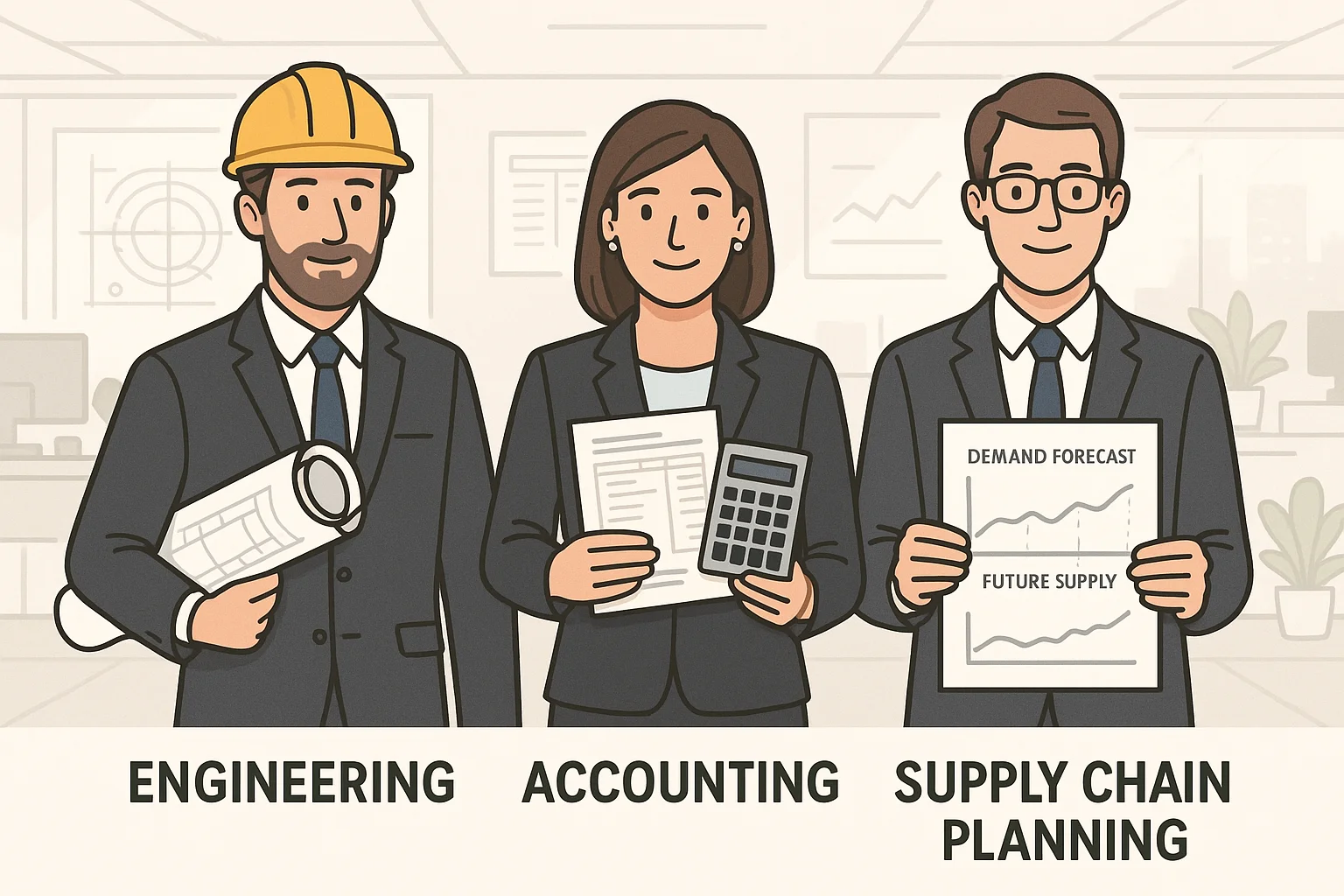
Engineering, accounting and law are widely recognised as professions with established bodies of knowledge and clearer education routes. Supply chain planning does not have one universal entry path in the same way.
That does not make it less skilled. In many ways, it makes deliberate development more important.
A clearer professional identity would help people entering planning understand that the role is not limited to operating a system or reacting to exceptions. It involves making decisions under uncertainty and balancing competing business objectives.
A customer service target may point toward more inventory. Working-capital pressure may point toward less. A supplier's minimum order quantity may improve purchasing efficiency while increasing the risk of excess stock. A production schedule may reduce changeovers but make the business less responsive to changing demand.
There is rarely a single setting or report that resolves these trade-offs. The planner needs enough knowledge to make the trade-offs visible, explain the consequences and support a decision that fits the business.
That is professional judgement.
Developing beyond the immediate role
For a planner, a useful development question is not only, “What tasks do I need to perform?” It is also, “What principles sit behind those tasks?”
Someone responsible for purchasing can benefit from understanding forecasting and inventory policy. A demand planner benefits from understanding lead times and production constraints. A warehouse or operations colleague moving into planning benefits from learning how inventory transactions become planning signals.
This does not mean everyone needs to become an expert in every supply chain field. Most roles will have a natural area of focus. But understanding the connections makes collaboration easier and prevents decisions being made in isolation.
It also makes career progression more deliberate. Rather than simply moving from planner to senior planner by handling a larger workload, people can build broader knowledge and stronger judgement over time.
Formal courses, certifications and university programs can support that development. So can internal training, mentoring, cross-functional exposure and structured self-study. The right route will vary by person and business.
The main point is that practical experience and professional knowledge should reinforce each other. Experience gives context to the theory. Professional knowledge helps people interpret experience, ask better questions and avoid learning every lesson through a costly mistake.
Questions to ask about your own planning role
A few questions can reveal whether a planning process is being understood as a discipline rather than just a set of tasks:
- Can the team explain why the system is recommending an action, not only how to process it? - Do people distinguish between a planning concept and the name of a software function? - Are terms such as lead time, forecast and safety stock understood consistently? - Do planners understand the trade-offs their decisions create for service, cost, capacity and inventory? - Is development focused only on system training, or also on planning principles and decision-making?
The answers do not need to be perfect. They can identify where better shared understanding would make the planning process stronger.
Key Takeaways
- Many people enter planning through practical roles rather than a formal planning pathway, and that experience is valuable. - Supply chain planning is more than a collection of transactions and urgent tasks; it is a discipline built on connected planning principles and business trade-offs. - Software terms such as planned orders, exception messages and MRP describe functions or outputs. Planners still need to understand the concepts behind them. - Industry terminology varies, so teams need a shared understanding of what their planning language means in practice. - Experience should complement professional knowledge, helping planners develop judgement rather than simply becoming more efficient at the tasks in front of them.